School Readiness
Create strong foundations for early learning.
Our School Success portfolio aims to increase the number of students in kindergarten through eighth grade who demonstrate meaningful growth and proficiency in literacy and math.
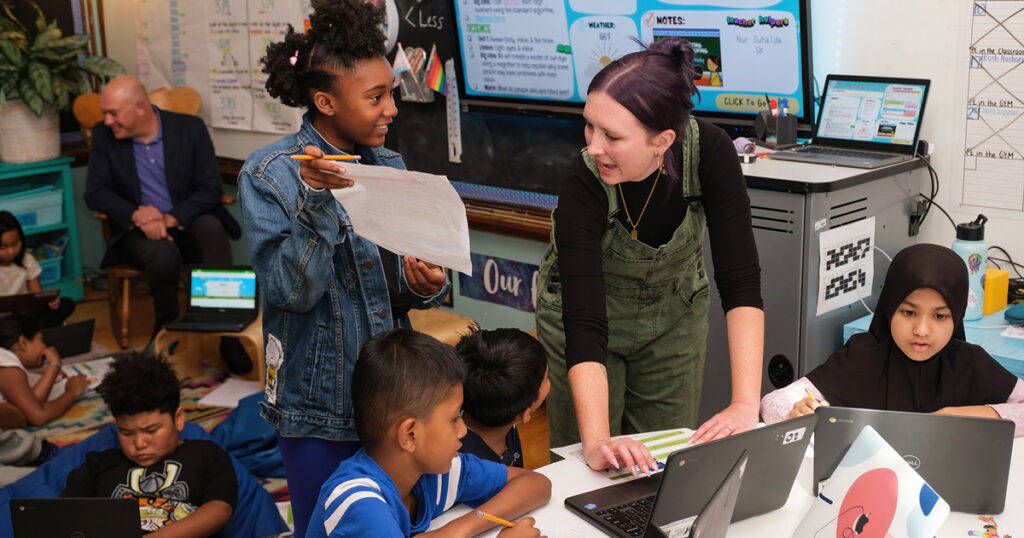
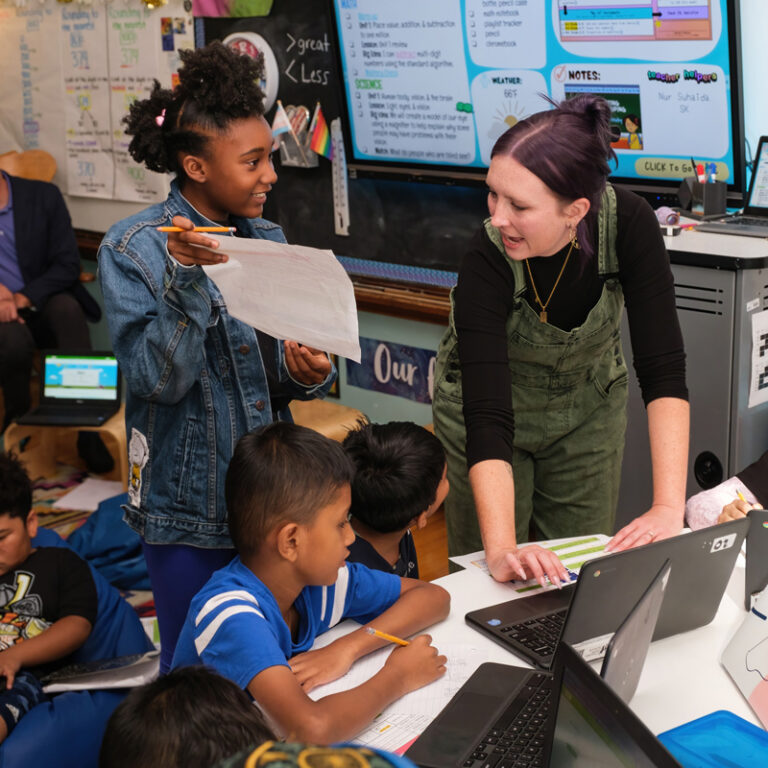
Courtesy of Modern Classrooms Project

High-Quality Instructional Materials
Support the development, scale, and implementation of coherent, high-quality curriculum and assessments.

Supported Educators
Expand access to, and the cost-effectiveness of, high-quality professional learning and coaching aligned with the science of learning that supports educators in facilitating rigorous, coherent instruction.

Differentiated Student Supports
Increase scale and cost-effectiveness of high-impact tutoring and other evidence-based differentiated supports that accelerate student learning.

Improved Learning Environments
Explore innovative models that optimize time, talent, and technology to strengthen teaching and learning.
Learn more about the grantees accelerating academic outcomes.

Leveraging AI to provide real-time feedback on math assignments.

Supporting teachers to enhance students’ reading and writing skills.
Expanding educator access to high-quality instructional materials.

Redesigning instruction to optimize classroom time and curriculum implementation.

Reimagining the teaching profession to improve outcomes for both educators and students.

Improving students’ early literacy skills through high-impact virtual tutoring.

Empowering teachers to drive their own high-impact professional learning.

Scaling an evidence-based math program to elementary schools across the country.
Learn more about our grantmaking and the organizations we fund.
The latest NAEP results reveal that many students have made steps toward post-pandemic academic recovery, but overall progress remains slow. In both reading and math, most fourth and eighth grade students performed below 2019 pre-pandemic levels, with one-third of eighth-grade students scoring below “NAEP basic” in reading—the largest share of students in the assessment’s history. These scores have serious implications for students’ academic achievement and engagement in learning: students not proficient in literacy by third grade are four times more likely to drop out of school, with a higher risk for low-income, Black, and Latino students. And, students scoring “advanced” on NAEP eighth grade math are four times more likely to attend college within five years and 30 times more likely to complete a four-year degree than peers scoring “below basic.”
Teachers are the most important factor in a student’s education, and quality and variability across and within schools impact both short and long-term outcomes for students, including income level as an adult. Yet despite their importance to learning, most educators still lack access to the kind of sustained, coherent professional learning that improves instructional quality. Only 30 percent of teachers reported receiving training aligned with their curriculum, despite strong evidence that pairing high-quality instructional materials (HQIM) with curriculum-based professional learning and coaching yields the greatest student gains. As a result, almost all teachers report that they supplement HQIM with additional materials, with most drawing on three or more materials to teach their classes. This layering of disconnected materials can negatively impact teachers’ time and students’ learning, highlighting the importance of instructional coherence across curriculum, assessment, professional learning, and differentiated student supports. In Virginia, for example, students in classrooms led by teachers with access to HQIM paired with aligned professional learning performed 50 percent higher on standardized assessments of math achievement than students in classrooms where teachers were given HQIM with no support.
Even the highest-quality edtech solutions only improve student outcomes when they’re implemented with fidelity. Too often, schools and districts experience diminishing returns as they scale high-quality programs because the conditions necessary for success—such as aligned schedules, teacher readiness, leadership support, and relevant resources—are not consistently in place. Recent research underscores this reality: an RCT of Zearn in Houston ISD found causal impacts of approximately .11 SDs on math achievement when teachers were required to use the tool at the recommended dosage of three lessons per week in year two of the study, compared to a null impact in year one without this implementation policy. And, a 2025 national tutoring study saw the largest effect (approximately 3.5 months of learning) in a New Mexico district where students received more than 2,000 minutes of tutoring per year—a dosage most closely aligned with best practice recommendations for high-impact tutoring.
Teachers are facing increased workload and an even broader range of student learning needs, with over half reporting that their schedules prevent them from focusing on core teaching responsibilities, and only one in three viewing their workload as sustainable. These pressures underscore the need for better solutions to organize people, time, and resources in schools to deliver stronger teaching and learning. One solution is organizing educators more strategically in flexible, team-based staffing models, which disrupt the traditional “one-teacher, one-classroom” approach while extending the impact of effective teachers and, in some instances, leveraging technology to rethink expectations for teachers’ time. Public Impact’s Opportunity Culture found that teachers previously performing on average at the 50th percentile produced student learning gains equivalent to teachers in the top quartile in math and nearly that in reading when placed on teams led by multi-classroom leaders with a record of high student learning growth. Next Education Workforce found that when teachers in the initiative were asked about their career plans five years from now, 62 percent indicated teaching as their plan, compared to 48 percent of teachers not on Next Education Workforce teams.
Research consistently shows the potential of high-dosage tutoring to improve student outcomes, and demand for tutoring remains strong: the share of schools offering high-dosage tutoring rose from 37 to 42 percent from December 2022 to June 2025. But many of these programs are at risk, with only 23 states now providing sustained funding for high-dosage tutoring. In this tightened post-ESSER fiscal climate, making tutoring programs less costly and more scalable while maintaining impact is key. One solution is hybrid tutoring: An RCT of Saga Education’s less expensive hybrid tutoring approach compared math achievement for students randomly assigned to hybrid tutoring versus those who continued with business-as-usual instruction. It found impacts of approximately 0.23 SDs, or about a year of learning, on math achievement for participating ninth graders in the hybrid program. Implementation fidelity is also key to success: a national study saw the largest effect of tutoring—about 3.5 months of learning—in a New Mexico district where students received more than 2,000 minutes of tutoring per year. Across all districts in the study, this most closely aligned with the dosage recommendations for implementing a high-impact model.
Discover additional insights and lessons learned
View our blogOur grantmaking and strategic support focus on three areas that together set children up for lifelong success.