



In Q3 2026, our foundation awarded 76 grants totaling over $28.8 million.
Our third quarter grantmaking spans portfolio areas, from helping students develop future-ready skills to advancing artificial intelligence (AI)-enabled approaches to professional learning, staffing, and tutoring—and building the evidence needed to understand what works for students. As always, we place an emphasis on grantmaking and strategic support that unlock innovation, evidence, and growth for our grantees.
Below, we highlight just some of the direct impact and ecosystem organizations we’re proud to support this quarter as we continue our 2026 grantmaking.
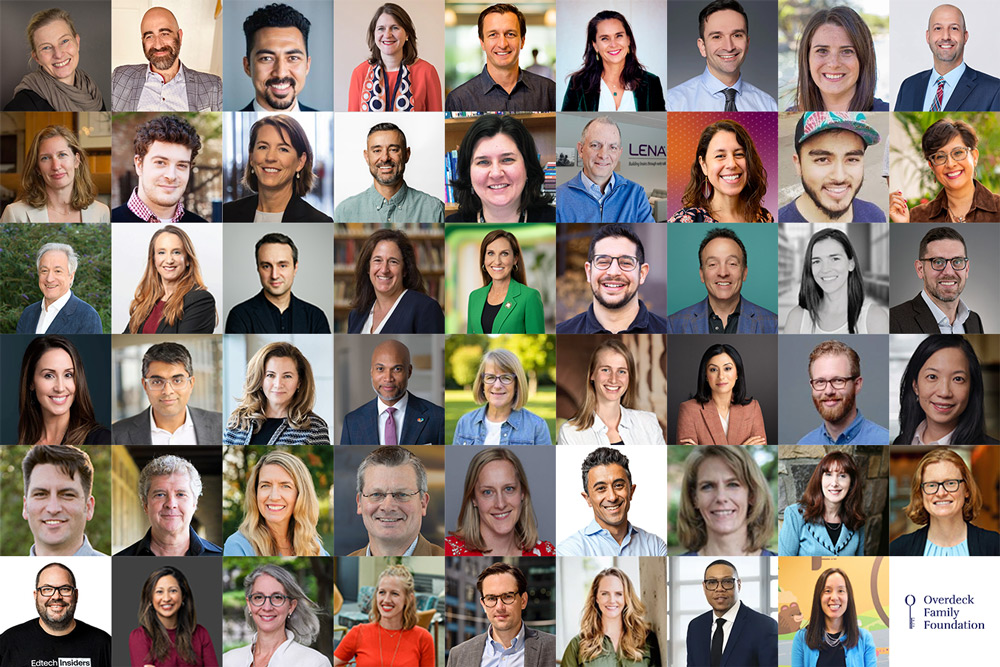
Photos from top left to right: Anja Kurki, Omar Guessous, Soren Rosier, Dacia Toll, Evan Stone, Kelly Stuart, Christopher Doss, Jamie Annunzio Myers, Dan Barnett, Robin Lake, Alex Sarlin, Marguerite Roza, Daniel Velasco, Jamie Mikeska, Stephen Hannon, Stacey Alicea, Yusuf Ahmad, Lynette Fraga, David Steiner, Jodi Grant, Andrea Pasinetti, Susanna Loeb, Jill Bramble, Kareem Farah, Alan Safran, Sam Olivieri, Steven Malick, Alice Huguet, Kumar Garg, Ariel Kalil, Jermaine Myrie, Elizabeth Cushing, Dora Demszky, Shalinee Sharma, Matt Miller, Sharon Huang, Andrew Grillo-Hill, Sean Reardon, Elizabeth Gaines, Kirk Walters, Michelle Maier, Paymon Rouhanifard, Melanie Livet, Katherine Bassett, Christina Weiland, Ben Kornell, Monica Bhatt, Rebecca Winthrop, Jessi Brunken, Peter Gault, Brittany Miller, Lewis Ferebee, and Caroline Hu Flexer
Unlocking Innovation and Growth (Direct Impact Grantees)
NEW GRANTEES/PARTNERSHIPS
New to the Future Readiness portfolio:
- MENTOR, which is dedicated to strengthening the quality and scale of youth mentoring with evidence-based standards, resources, and field-building support. The organization received a one-year pilot grant of $330,000 to support the development and dissemination of an evidence-based playbook identifying strategies—including technology-enabled and peer mentoring models—that expand access to high-quality mentoring while preserving relationship quality.
- OKO Labs, an AI-powered platform that facilitates small-group collaborative learning. The organization received a one-year pilot grant of $200,000 to support testing and publishing insights related to its multidimensional Skills Profile to measure its impact on durable skills like communication, collaboration, and critical thinking.
- PeerTeach, an AI-enabled peer learning model for math. The organization received a one-year pilot grant of $185,000 to support the development and validation of an AI-powered Coaching Identity System to measure its impact on collaboration, teamwork, and relationship-building skills.
- Playworks, which redesigns recess to help students build relationships, develop social-emotional skills, and strengthen engagement. The organization received a one-year pilot grant of $310,000 to scale its TagTeam partnership model, expanding access to structured, play-based experiences for 16,000 students.
New to the School Success portfolio:
- Coursemojo, which offers an AI-powered teaching assistant that supports curriculum-aligned English language arts instruction by providing students with real-time feedback and teachers with actionable insights into student thinking. The organization received a 15-month pilot grant of $400,000 to test whether AI-enabled teacher planning and professional learning tools can strengthen the implementation of high-quality instructional materials (HQIM) and improve teacher practice and student outcomes; it will share lessons from the pilot with the field.
- Step Up Tutoring, a 1:1 virtual, out-of-school tutoring program for literacy and math learning in second through eighth grade. The organization received a one-year pilot grant of $300,000 to strengthen the evidence base for its at-home virtual tutoring model and assess its potential to improve student learning at scale.
- Timely, which helps K-12 school systems build master schedules that reflect their instructional, staffing, and budget priorities. The organization received a one-year pilot grant of $350,000 to test whether AI-enabled scheduling technology and implementation support can help five districts translate strategic staffing models into workable school schedules that embed key staffing, teaming, and collaboration structures.
RENEWALS AND COMMITMENTS
$3,000,000 (second disbursement of a 2.5-year grant) to LENA to support continued work to make LENA Grow easier to implement, more scalable, and less costly while maintaining its impact on children’s early language development.
$3,000,000 (year two of two-year grant) to Zearn to support the continued implementation of Louisiana Lift, as well as product enhancements designed to increase the number of students who use Zearn at recommended dosage.
$1,244,908 over two years to Boys & Girls Clubs of America to strengthen its ability to measure, improve, and scale future-ready outcomes such as communication, collaboration, and relationship-building. The organization will use the funding to incorporate future-ready measures into its national quality improvement systems, informing practices across a network that serves more than four million youth annually.
$1,000,000 (year two of a two-year grant) to Collaborative Classroom to support continued growth of its early childhood portfolio, including SEEDS of Learning Professional Learning, Every Child Ready, and Pinecone Path, resulting in increased adoption of high-quality curricula and professional learning across Pre-K settings.
$1,000,000 (year three of a three-year grant) to support Saga Education in making its tutoring models more scalable and sustainable while maintaining implementation quality and student outcomes.
$900,000 over three years to the New Jersey Tutoring Corps Inc. to support its embedded school-year tutoring program, reaching more than 2,500 students throughout the state.
$650,000 (year two of a two-year grant) to the Center for Outcomes Based Contracting to scale high-quality outcomes-based contracting through standards development, digital tools, shared data infrastructure, credentialing, and technical assistance for sales and implementation.
$500,000 (year two of a two-year grant) to Modern Classrooms Project to support product innovation, go-to-market strategy, and testing of a scalable instructional model that strengthens HQIM implementation and student outcomes.
$400,000 over one year to support Ensemble Learning in testing and refining its HQIM-aligned professional learning and coaching model, designed to help educators maintain grade-level rigor while increasing access for multilingual learners.
$375,000 over two years to support Students 2 Science‘s work in New Jersey as it expands programming at its Apollo Technology Center.
$350,000 over one year to support the National 4-H Council in developing and evaluating a digital skills tracker that helps middle school youth build and demonstrate future-ready skills through structured reflection with trusted adult mentors.
$300,000 over one year to Khan Academy to support early implementation testing of Khan Academy Kids’ Pre-K skills assessment in publicly funded early learning settings.
$300,000 over one year to PBS SoCal to determine how to best position its Family Math Play & Learn app within its broader Family Math initiative.
$300,000 over one year to Quill.org to support the design and testing of its state-assessment-aligned paragraph-level feedback tool.
$250,000 (year two of a two-year grant) to Blue Engine to improve the scalability and financial sustainability of its teacher coaching model, which helps schools and systems strengthen instruction for students with diverse learning needs.
Unlocking Evidence: RESEARCH and FIELD BUILDING
Ecosystem grants are designed to clear the path to scale for our direct impact grantees and strategies.
$2,650,000 over two years to Afterschool Alliance to support states in embedding afterschool programs within Portrait of a Graduate frameworks while expanding sustainable support for high-quality afterschool programs.
$1,750,000 over 2.5 years to the Center for Universal Education at Brookings to help launch a national initiative examining how wide and narrow uses of AI affect student learning, agency, engagement, and relational trust.
$800,000 (year two of a two-year grant) to the Research Partnership for Professional Learning to complete multiple studies designed to strengthen the evidence base for effective professional learning, with a focus on AI-enabled models with potential to improve teacher practice, student outcomes, and professional learning scalability.
$750,000 (year two of a two-year grant) to support EdReports in accelerating review capacity, expanding Pre-K and science reviews, and strengthening organizational sustainability.
$750,000 over 2.5 years to the University of Chicago Education Lab to support research on whether AI can help schools identify which students require human-delivered interventions and which can achieve comparable outcomes through technology-enabled supports.
$700,000 over 2.5 years to WestEd to support a quasi-experimental evaluation of the Zearn Louisiana Lift Initiative, examining the initiative’s impact on student math achievement. This research will generate an independent proof point on whether Zearn can improve math outcomes when implemented with fidelity at scale.
$650,000 over 2.5 years to the National Implementation Research Network at the University of North Carolina’s Frank Porter Graham Child Development Institute to support a matched-comparison study of Rivet Education’s Instructional Materials Implementation Tool. The study will compare schools using Rivet’s structured implementation roadmap with matched schools to understand the impact on implementation capacity, teacher experience and practice, and fidelity to HQIM, with student achievement analyzed as an exploratory outcome.
$639,000 (year two of a two-year grant) to the Stanford SCALE Initiative, which aims to improve the efficacy of high-impact tutoring and generative AI in K-12 education. The funding will support the continued work of the National Student Support Accelerator and the AI Hub for Education, including tools and advising for tutoring sustainability and implementation quality, evidence reviews and briefs on AI in K-12, and partnerships with local education agencies and AI edtech providers.
$600,000 over two years to the Edunomics Lab to incorporate return-on-investment into district analyses of student achievement, procurement decisions, and technology audits.
$600,000 over two years to MDRC to support a mixed-methods study examining how high-quality Pre-K assessment systems are implemented and used across approximately 66 classrooms serving 750 children in Virginia, DC Public Schools, and Union City, New Jersey.
$600,000 over two years to the Education Policy Initiative at the University of Michigan to examine the statewide implementation of Mississippi’s new evidence-based Pre-K curriculum model across approximately 100 classrooms serving 1,800 children, and to better understand whether stronger curricular implementation is associated with gains in children’s math and literacy outcomes.
$525,000 over two years to The Educational Opportunity Project at Stanford University to support the next phase of creating the first national Kindergarten Readiness Assessment database.
$500,000 over two years to Renaissance Philanthropy to support the development and public release of two open benchmark datasets that help researchers, developers, and educators evaluate whether AI tools preserve instructional quality and support collaborative learning in K-12 education.
$450,000 over 18 months to Educators for Excellence to engage educators and build awareness of the conditions that support effective adoption of strategic staffing models in New York and Connecticut.
$400,000 (second disbursement of a 3.5-year grant) to the American Institutes for Research to support a randomized controlled trial (RCT) of TalkingPoints’ impact on student attendance and academic achievement in 64 Pre-K and elementary schools across three districts.
$400,000 over one year to the Children’s Funding Project to support the Fund IRL coalition in creating and disseminating guidance that helps states invest social media settlement funds in high-quality out-of-school-time programs.
$400,000 over 18 months to ETS Research Institute to support the development and refinement of three AI-powered practice simulations for third through fifth grade math teachers. ETS will test whether the simulations strengthen teachers’ productive questioning in real classroom math discussions and whether outcomes differ depending on the level of professional learning support provided.
$400,000 over two years to RAND to support a school-level RCT of Edia, an AI-enabled data tracking and attendance platform. Resulting research will provide insight into whether Edia reduces absenteeism in Rhode Island by helping schools identify attendance barriers earlier, facilitate two-way family communication, automate routine attendance management, and direct staff time toward students and families needing more intensive support.
$350,000 over one year to Playlab to support the research and learning component of its AI Lab Schools initiative, a 20-school cohort exploring how schools incorporate AI as a core design principle for teaching, learning, and operations.
$350,000 over 1.5 years to Stanford University to support the Stanford Education Data Archive (SEDA) in developing a public, district-level NAEP proficiency database and visualization platform, which helps policymakers, researchers, and education leaders monitor local progress toward nationally comparable reading and math proficiency standards.
$332,500 to Reach Out and Read (year three of a three-year grant) to support a quasi-experimental study estimating its impact on caregiver-pediatric relationship quality, patient satisfaction with pediatric care, and the quality of the home literacy environment.
$300,000 over one year to the Center on Reinventing Public Education to support research on how early adopter districts and states select, implement, and monitor AI tools, with the goal of producing two research briefings and related implementation resources for state, district, funder, and edtech audiences.
$300,000 over two years to Edtech Insiders to synthesize data, create resources, and generate insights about the efficacy of AI-enabled K-12 math and ELA tools.
$300,000 (year two of a two-year grant) to Johns Hopkins University to support completion of a quasi-experimental evaluation of Modern Classrooms Project’s professional learning and aligned curriculum resources tool on instructional quality and fourth and fifth grade math achievement.
$300,000 over one year to Kira to support a mixed-methods study of whether AI-driven synthesis between diagnostic data, curriculum, and daily instruction improves math outcomes and teacher practice across 20-30 classrooms.
$290,000 (year two of a two-year grant) to the Stanford EduNLP Lab to support a mixed-methods study of AI tools designed to improve the quality and efficiency of teacher feedback on student writing.
$250,000 (second disbursement of a 3.5-year grant) to Mathematica to support the continued evaluation of the Inspired Teaching, Exceptional Learning (ITEL) initiative, which brings together HQIM and strategic staffing. The research will evaluate the impact of ITEL on teacher practice, delivery of high-quality instructional content, and student achievement in elementary and middle school.
$210,000 over 1.5 years to the University of Chicago Behavioral Insights and Parenting Lab to support an RCT of Chat2Learn, an AI-enhanced parent engagement tool designed to improve home language environments and school readiness outcomes for low-income preschool and kindergarten children.
$153,344 (second disbursement of a 2.5-year grant) to WestEd to support completion of a two-cohort quasi-experimental evaluation of DiscoverE’s Future City program and its impact on students’ engineering knowledge; science, technology, engineering, and math (STEM) motivation; and related outcomes.