




Capacity-building support is a critical component of our foundation’s funding model, helping organizations strengthen the systems, skills, and strategies needed to advance sustainable, cost-effective impact at scale for all students. Our approach is grounded in trust-based partnerships and a tiered model that matches high-quality, timely support to each grantee’s evolving needs.
Tier 1 of the model, received by every grantee, is coaching and strategic guidance from our program team. Tier 2 is additional support from cross-functional staff with expertise in program evaluation, organizational development, and communications; it’s available to a subset of grantees. When organizations need more specialized assistance, we connect them with Tier 3 support—external partners who offer technical assistance in areas such as program innovation, evidence-building, sustainable growth, or organizational strategy.
Capacity building is one of several ways we believe we can help nonprofit organizations achieve growth. As our efforts have expanded over the last few years, so has our focus on understanding whether and how these supports are making a difference for our grantees. To better measure our impact, we created a detailed evaluation framework that could assess the short-, medium-, and long-term outcomes of our capacity-building work.
Our impact measurement methodology prioritizes learning and collaboration with minimal burden on grantees. Throughout the evaluation process, we leverage existing data sources, only collecting high-priority data, and partnering closely with technical assistance providers to ensure our approach is both rigorous and practical.
In the spirit of our core value to “learn better, together,” we’re detailing what we’ve learned on this journey as we continue to iterate our approach.
Developing a measurement approach
We began by developing a logic model that maps capacity-building activities across our three tiers, the short-, medium-, and long-term outcomes we aim to impact, and how those outcomes connect to our goal of cost-effective, sustainable impact at scale.
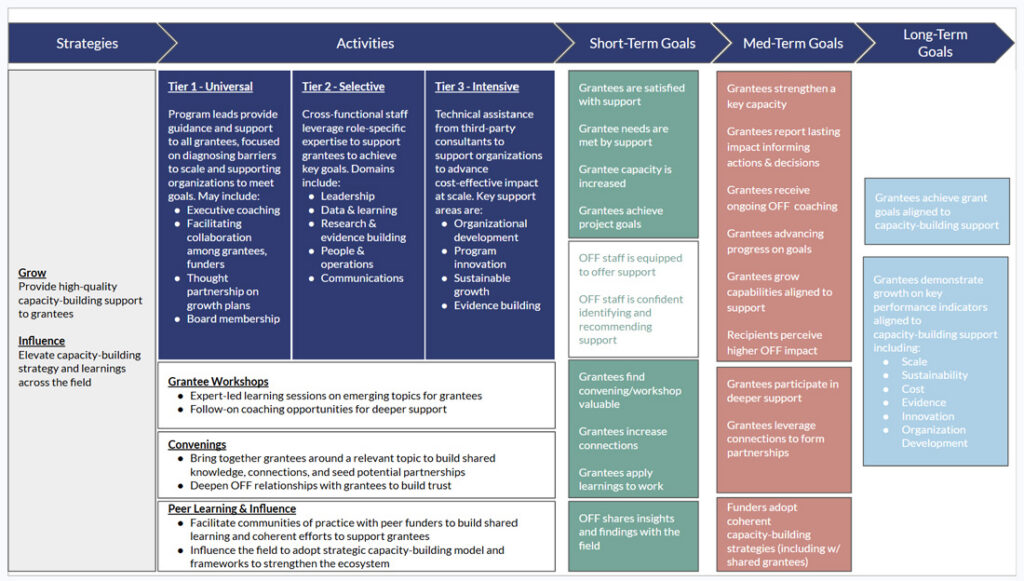
With this foundation in place, we then developed a measurement, evaluation, and learning framework to identify the highest-priority data needed to consistently assess progress. Our measurement approach captures impact across three different time horizons, each focused on tracking meaningful outputs and outcomes over time.
Using this framework, we’re hoping to learn:
- What role does capacity-building play in strengthening short-, medium-, and long-term organizational growth and impact?
- Which supports across tiers deliver the greatest impact relative to cost?
- What is the right sequencing of support to drive the highest level of impact over the right period of time?
Short-term (within three months): Are we meeting immediate needs?
To assess whether we are meeting short-term goals, we focus on measuring four key indicators:
- Grantee satisfaction with the support;
- Alignment of support with organizational needs;
- Contribution of support to near-term organizational goals; and
- Effectiveness of support delivery and strength of provider partnerships.
We gather this data through a brief survey administered at the conclusion of each engagement. We also conduct project closeout calls that allow grantees to candidly share insights, implementation efforts, and additional support needed from the foundation. This approach allows us to capture timely quantitative and qualitative feedback on quality, relevance, and early signs of capacity development without overburdening grantees. Year-round, our team uses these insights to inform continuous improvement, both in how we scope support and how we partner with providers.
Medium-term (six to 12 months): Are changes sticking?
The ultimate goal of our capacity-building supports is sustained impact. To get there, we examine whether our support leads to meaningful changes in how organizations work, including how they make decisions, operate, and apply new skills over time. We see these shifts as leading indicators of longer-term progress toward their goals.
To understand medium-term impact, we use a few complementary approaches:
- Follow-up engagement six months post-project: We survey organizations to understand whether they’re still using the tools, skills, or systems developed; how these capacities are shaping their decisions and practices; and what challenges they’re facing, and what additional support they may need.
- Provider-informed diagnostics: In partnership with our Tier 3 providers, we use co-developed pre- and post- engagement assessments to understand how organizations’ skills and capacities have changed. These help us measure progress in areas that matter for broader organizational growth.
- Comparative perception data: Through our biannual Grantee Perception Report in partnership with the Center for Effective Philanthropy, we compare responses from organizations that received capacity-building support with those that did not on measures such as trust, influence, and perceived impact. This helps us understand how grantees experience our support relative to our funder peers and the broader field.
Long-term (more than one year): Are we seeing durable change?
Over the long term, we assess progress toward organizational goals and performance on key outcomes. We do this by focusing on two primary areas:
- Progress toward grant goals: Our program team works closely with grantees to set meaningful grant goals that reflect their priorities. We then align capacity-building support to help build the skills needed to reach those goals. Over time, we assess whether and how capacity-building support accelerates organizations’ progress toward their goals.
- Progress on key performance indicators: We also track changes in a set of core indicators that reflect long-term, cost-effective impact at scale. These are standard metrics that grantees already report on, covering areas like organizational development, innovation, growth, financial sustainability, and evidence of impact.
Taken together, these measures allow us to assess whether capacity-building support contributes to durable improvements in organizational effectiveness and strength.
What we’re learning so far
While our data collection and analysis are ongoing, early signals point to positive and consistent trends across time horizons.
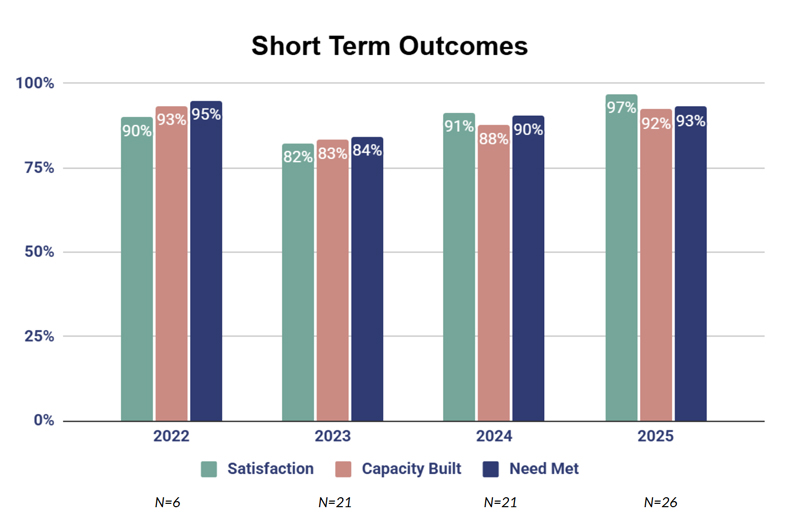
In the short term, organizations report high satisfaction with the quality of support received. Grantees indicate that engagements address high-priority needs and contribute to meaningful gains in capacity.
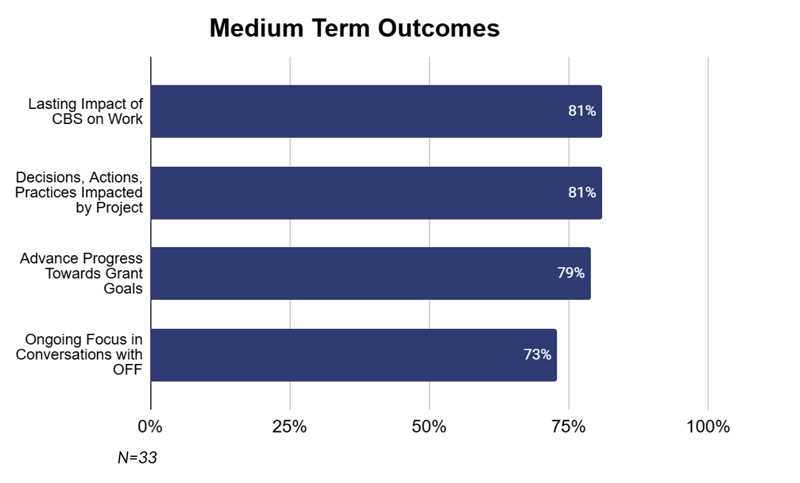
In the medium term, we see evidence that these gains translate into practice. Six months after receiving their capacity-building support, grantees report applying new tools, insights, and capabilities to inform decision-making and shifting organizational behavior in ways that support more cost-effective impact at scale. For example, after Arizona State University’s Next Education Workforce completed a series of intensive capacity-building supports from 2022 to 2024, Kaycee Salmacia, head of program, partnerships, strategy and operations, said, “[These supports] helped us develop the knowledge, skills, and mindsets we needed during this stage of our business growth.”
In addition, skill-based diagnostics show meaningful growth in targeted competencies, such as budgeting and financial planning, strategic clarity, revenue strategy, and capacity for scale, with teams often improving from the 40th-50th percentile pre-engagement to the 80th-90th percentile post-engagement.
Findings from the Grantee Perception Report indicate that grantees who receive capacity-building support report more positive perceptions than those who do not, particularly in their trust in and relationship with the foundation, and the foundation’s impact and influence on their work and the fields they operate in.
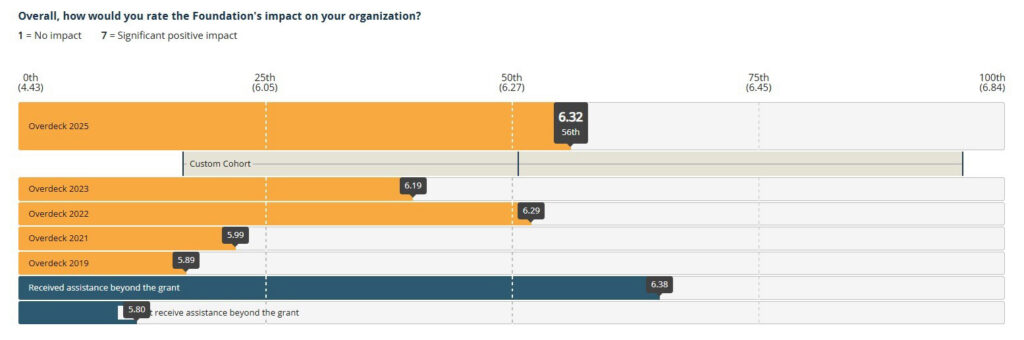
Courtey of Center for Effective Philanthropy
Over the long term, we’ve seen strong organizational outcomes among grantees who’ve received capacity-building support, particularly in areas aligned with the support provided. While we do not attribute these outcomes solely to capacity building, the patterns suggest it plays a meaningful role in accelerating progress.
Participating grantees have experienced an average of:
- 18 percent reduction in costs;
- 114 percent increase in earned revenue;
- 125 percent increase in programmatic reach; and
- 79 percent grant goal achievement aligned to capacity-building support.
The nonprofit DiscoverE, for example, engaged in a series of capacity-building supports designed to help advance the scalability, sustainability, and impact of its signature program, Future City. Over the course of several years, these supports contributed to DiscoverE designing and launching a validation study, in addition to increasing its earned revenue by 65 percent and reach by 24 percent from 2024 to 2025. Kathy Renzetti, executive director and CEO of DiscoverE, said, “Overdeck Family Foundation’s capacity-building supports have been an invaluable resource for our team as we determine a business model that allows us to scale our programs for greater impact.”
Taken together, these findings suggest that capacity-building support is not only well received in the moment, but is effective in shifting how organizations operate, with sustained improvements in organizational performance over time.
Looking ahead
Our measurement, evaluation, and learning approach continues to evolve as we learn alongside grantee partners and providers. By grounding our capacity-building in a clear theory of change and pairing it with thoughtful ongoing, intentional measurement, we aim not only to strengthen our own practice, but also to contribute a broader understanding of what effective capacity-building can look like.
Aligned with this goal, in 2026 we’re focusing our learning on several key questions:
- Is Tier 3 support more impactful when paired with timely, relevant Tier 1 and 2 support?
- What are the most effective ways to support grantee partners navigate the current education funding and policy environment?
- What supports effectively promote innovation to become more cost-effective in a constrained fiscal environment?
- How are nonprofits leveraging strategic partnerships to support scale, impact, and sustainability goals, and what role can funders play?
We hope to share lessons learned against these questions over the next several years. By doing so, we aim to both deepen our impact on education nonprofits and contribute meaningful insights that can advance how philanthropy delivers and understands effective capacity-building support. To follow our Measurement, Evaluation, and Learning work and explore spotlights on grantee work, visit our website.
Read a Center for Effective Philanthropy interview with Lucy Brainard, director of portfolio success and operations, to learn more about how the Foundation structures its capacity-building support to maximize impact for grantees.