Back

During the COVID-19 pandemic, national rates of chronic absenteeism nearly doubled, rising from 15 percent in 2019 to 28.5 percent in 2022. Two years later, those numbers still haven’t returned to pre-pandemic levels, with 22 percent of students considered chronically absent in SY 2024-25.

The consequences for learning are profound: students who are chronically absent in the early grades are less likely to read proficiently by third grade, more likely to fall behind academically, and at higher risk of dropping out of high school. But despite the urgency of this issue, the field lacks rigorous evidence on what drives chronic absenteeism and which solutions are most effective at reducing it. Policymakers, school leaders, and teachers have long recognized the importance of attendance, but have often lacked clear guidance on where to focus resources and which strategies are most likely to succeed.

Over the past five years, Overdeck Family Foundation has invested over $4 million in research to better understand the drivers of and solutions to chronic absenteeism, as well as field-building and communications efforts that helped disseminate those findings to state and district decision-makers. Our goal is to ensure that policy decisions are informed by rigorous and actionable data that help increase student attendance, engagement, and achievement.

10 grantees supported

Unlocking Evidence

Research to better understand the causes of and solutions to chronic absenteeism.

Overdeck Family Foundation has invested in research to better understand the causes of and solutions to chronic absenteeism, with the goal of driving evidence-based decisions and policies that effectively address the challenges for students, families, and schools. Here’s what we’ve learned over the past five years:

  1. Even modest amounts of absence are linked to lower academic performance. Research using longitudinal data from multiple states found that increases in absenteeism—whether above or below the chronic threshold—are consistently associated with declines in student achievement in both math and reading, emphasizing that attendance matters across the spectrum of absence. Absenteeism is an even stronger predictor of poor academic performance now compared to before the COVID-19 pandemic.
  2. School climate, connection, and trust are powerful predictors of attendance. Overdeck Family Foundation-funded research in Chicago found that students who feel safe, connected to adults and peers, and trusted by their school community have substantially lower rates of chronic absenteeism, and that these climate-related predictors are even stronger post-pandemic than they were before. Research from the University of California, Davis also finds that early, strengths-based family engagement, including clear communication about attendance expectations and supportive outreach when absences first emerge, can meaningfully improve student attendance and reduce chronic absenteeism, particularly in the early grades.
  3. Low-cost, behaviorally informed strategies can reduce absences. Evidence from Overdeck Family Foundation-funded work conducted by the University of Chicago Behavioral Insights and Parenting Lab and Texas Tech University shows that early warning systems combined with timely, family-focused communication—such as targeted messaging and outreach—can improve attendance outcomes and reduce chronic absence by providing families with concrete, actionable information.
  4. Policy levers like school cell phone restrictions show promise, but are not silver bullets. A rigorous quasi-experimental study of Florida’s statewide bell-to-bell phone ban found modest positive effects on standardized test scores, with much of the improvement explained by significant reductions in unexcused absences. Importantly, effects were fairly small, suggesting that phone bans alone are unlikely to lead to a full academic recovery. We’re funding the Center for Education Policy and Research at Harvard to conduct new multi-state research that explores a broader set of in- and out-of-school technology policies to better understand how different approaches influence student attendance, engagement, and achievement.

  5. Comprehensive, sustained efforts are needed to turn the tide. While national and local data point to some recent improvements, absenteeism remains well above pre-pandemic levels and varies widely by context. Together with rigorous local research and emerging national evidence, organizations like our grantee Attendance Works are taking a cross-partisan approach to working with state leaders to support evidence-informed decision-making in 2026 and beyond. In 2024, the organization launched its 50% Challenge, challenging state and local leaders to cut chronic absence rates in half over five years. To date, 18 states, including Alabama, Rhode Island, and California, have signed on.

Explore Other Impact Areas

Discover how we’ve helped grantees unlock innovation, evidence, and growth.

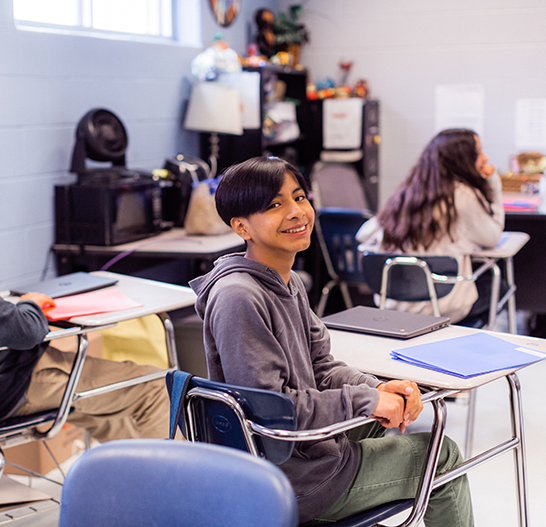
Young boy sits in desk at school

Courtesy of TalkingPoints

Follow us

Sign up for our newsletter.

Subscribe to Overdeck Family Foundation’s newsletter to stay up-to-date on our latest news and resources.