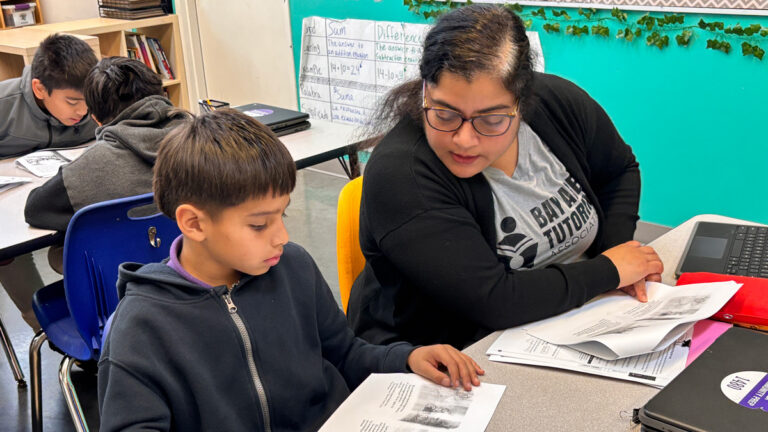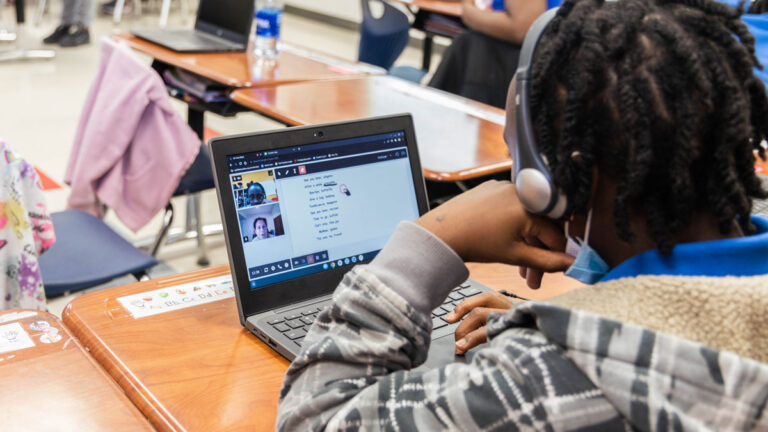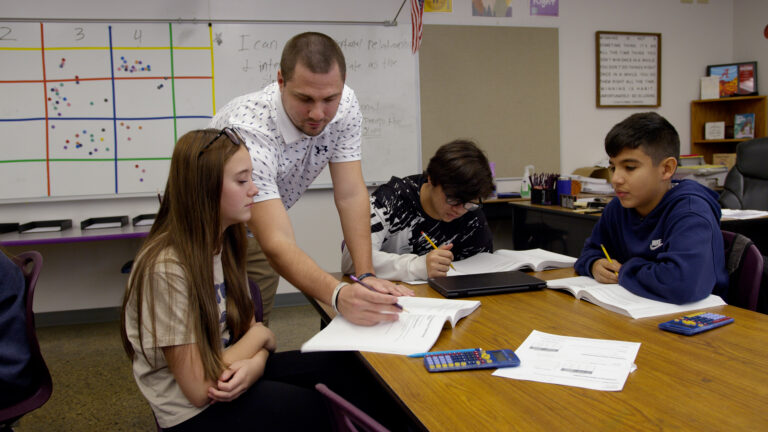





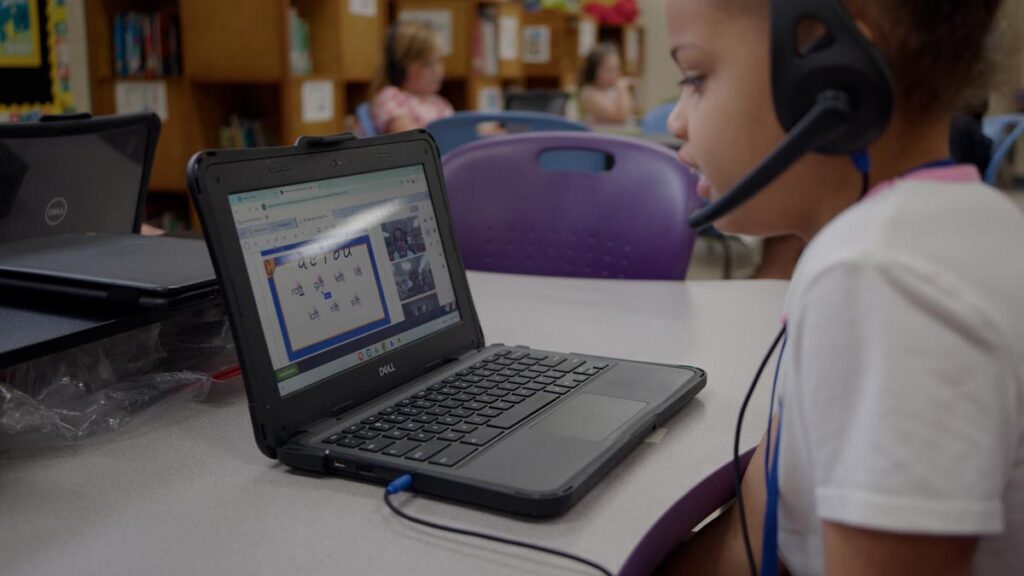
For decades, policymakers, practitioners, and researchers have sought ways to provide students with more individualized instruction. High-impact tutoring has emerged as one of the most effective approaches, with rigorous research showing that consistent, targeted support from a tutor can substantially accelerate student learning.
But not all tutoring models are equally effective, and impacts often shrink as programs scale, highlighting the challenge of delivering the core elements of effective tutoring consistently to large numbers of students. High-impact tutoring also requires significant investments in people, training, scheduling, and sustained instructional time, all of which can become harder and more expensive to manage at scale. Research from the University of Chicago Education Lab’s Personalized Learning Initiative shows that even newer, lower-cost models cost approximately $1,200 per student, while more traditional approaches can cost $2,000 or more.
Artificial intelligence (AI) is being incorporated into tutoring experiences in several ways, from providing individualized instruction and feedback directly to students to helping human tutors understand and respond to student needs. These approaches could expand access to individualized support while reducing some of the staffing and delivery constraints that make traditional tutoring expensive and difficult to scale.
While we have evidence of what works in a traditional in-person or virtual tutoring model, early studies are beginning to provide a clearer picture of the conditions under which AI can strengthen tutoring and support learning. These lessons can guide the field to make strategic decisions related to product development and growth. Four findings stand out.
1. AI can strengthen academic performance during use, but improvements do not always transfer to independent practice
When students have access to AI, they often perform better on the work immediately in front of them. But a growing number of studies find that those improvements do not mean that students perform better once the technology is removed.
In a randomized controlled trial (RCT) of nearly 1,000 high-school students, researchers tested two versions of a generative pre-trained transformer (GPT)-powered math tutor. Students using a relatively unconstrained version performed substantially better on practice problems with AI, but scored 17 percent worse than the non-AI control group when the tool was removed. A second version was designed specifically to support learning, using teacher-provided solutions and common student errors to provide hints rather than answers. These students also performed better during practice, but when the AI was removed, they performed about the same as students who had never used it. The guardrails appeared to prevent the negative effects of the more open-ended AI tool, but the gains students experienced during practice still did not translate into stronger independent performance.
A recent RCT of more than 6,000 middle-school students found a similar pattern, testing a math practice platform with and without AI tutoring and separately varying whether students had to answer three questions correctly in a row before moving on. During a single class period, AI helped students work through mistakes more accurately, but those benefits generally did not translate into better performance on an independent test one week later. Among students subject to the mastery requirement, those with AI support were about three percentage points more likely to correctly answer the test question aligned with the first practiced exercise than those without AI. Like with human tutors, AI supports may require substantial extended practice time before use translates into independent understanding and test performance.
When students have access to AI, they often perform better on the work immediately in front of them. But a growing number of studies find that those improvements do not mean that students perform better once the technology is removed.
2. Purpose-built AI tutors may have more lasting impact on student learning
Growing evidence finds reason to believe that how AI tutors are designed matters, particularly whether they help students work through problems themselves or make it easier to arrive at the right answer.
Purpose-built AI tutors, defined as those with specific pedagogical guardrails, curriculum alignment, and structured prompt engineering rather than open-ended answer engines, have shown more ability to produce learning that extends beyond the immediate interaction. In a recent experimental study of 929 secondary-school students in England, students who used Medly—an AI-powered platform with curriculum-aligned science practice problems—for four weeks to practice and study biology, chemistry, and/or physics performed 0.33 SDs better on a subsequent curriculum-aligned science assessment than students who continued with their usual independent study. Importantly, the assessment included new questions that students had not practiced with the AI, providing some evidence that students were learning, rather than simply performing better with the tool. The results are promising, though the study had substantial attrition, focused on students taking advanced high school courses, and did not examine whether the gains persisted over a longer period.
Recent research on Goblins, an AI-powered math platform used with teacher guidance that allows students to type, draw, or speak as they work through problems and receive personalized feedback, found similar results among a more generalizable population of more than 6,000 middle-school students. Researchers used propensity score weighting to compare similar students with different levels of Goblins use. Students who solved at least two problems per week scored 0.11 standard deviations higher in math, as measured with the NWEA MAP assessment, than students with little or no use. Gains on average increased with usage, reaching 0.31 standard deviations for students solving 20 or more problems per week. Because students were not randomly assigned, however, the study cannot rule out other differences between higher- and lower-use students, and the study doesn’t allow for causal inference. To address that limitation, Goblins is now working with Accelerate to launch an external RCT to get a more accurate estimate of impact on student achievement.
Together, the early evidence suggests that AI-enabled tools that preserve opportunities for students to reason, work through mistakes, and demonstrate mastery may be more likely to support learning. More rigorous research is needed to understand whether these gains transfer to stronger independent performance, persist over time, and translate into broader measures of achievement like standardized test performance.
3. Access to an AI tutor does not guarantee sustained, productive use
A familiar pattern from earlier generations of education technology is also showing up in AI-enabled tutoring: students often use supplemental tools far less than intended. Laurence Holt has described this as the “5% problem”—even when digital learning products show strong results among consistent users, relatively few students ultimately reach the recommended level of usage.
In a Stanford SCALE study of 355 elementary students, nearly half of students randomly assigned to independently use an AI literacy platform never used it at all. Among students who did, average use was only two to five minutes per week. Adding an in-person tutor focused on motivation, accountability, and troubleshooting increased usage, but engagement remained well below the intended dosage.
A two-year randomized study across 18 Tennessee middle schools found that students assigned to use Khan Academy with its AI chatbot, Khanmigo, made modestly larger gains in math, as measured with NWEA MAP scores, than students who continued with the district’s existing math interventions. But students rarely used the AI chatbot itself. While 96 percent tried Khanmigo at least once, the typical student only used it during about one-third of the days they practiced and in just 17 percent of exercises where they made a mistake. The overall learning gains were similar to those found in earlier studies of Khan Academy without AI, making it difficult to know whether the Khanmigo AI added much beyond the benefits of Khan Academy practice itself.
These findings reinforce the longstanding lesson from education technology: availability and usage are different things. They also raise an important research question about whether newer AI tools can generate the sustained, productive engagement needed to improve learning, particularly among students who are least likely to independently seek out additional academic support.

Courtesy of the National Student Support Accelerator
4. Combining AI and human tutors may unlock the biggest gains in student learning
There is also encouraging evidence on tutoring models that integrate AI with human support.
In a year-long study, researchers compared 356 seventh graders who used the adaptive math learning platform i-Ready alongside virtual human tutors with 317 students from the previous year who used i-Ready without human tutoring. After using propensity score matching to account for differences between the groups, researchers found that students receiving human tutoring alongside i-Ready progressed faster, ending the year 0.36 grade levels ahead of the AI-only group, using the internal i-Ready measure of math skills and proficiency. Importantly, however, there was no overall difference between the groups on standardized state math assessments.
Other work suggests that AI support and feedback could be particularly helpful for improving the quality of virtual tutoring, in turn boosting student outcomes. For example, Stanford’s Tutor CoPilot gives tutors real-time suggestions about how to respond to students. In an experimental study involving more than 700 tutors and 1,000 students, students whose tutors had access to CoPilot were four percentage points more likely to master math topics based on exit tickets at the end of tutoring sessions. The gains reached nine percentage points among students working with tutors who had received lower quality ratings before the study. CoPilot also changed how tutors interacted with students: tutors using it were more likely to ask questions that encouraged students to explain their thinking. The study did not examine whether those improvements carried over to broader measures of math achievement, so it is still unclear whether CoPilot can improve policy-relevant and longer-term achievement outcomes.
A third model uses humans to oversee the instruction AI provides. In an experimental study from Eedi and Google DeepMind, expert human tutors reviewed AI-generated responses before they reached students. The tutors approved more than three-quarters of the AI-generated messages with little or no editing. Students receiving human-supervised AI tutoring performed at least as well as students receiving human tutoring and were 5.5 percentage points more likely to correctly answer the first question when they moved on to a new math topic. Further work examining a larger sample with a longer follow-up time period will be released by the end of October 2026.
Together, these studies suggest that dividing the work between humans and AI may help scale individualized support without substantially reducing the impacts of traditional tutoring on student learning. More research is needed to understand which combinations of human and AI support work best, for which students, at what cost.
Prioritizing stronger evidence on AI-enabled tutoring and personalized learning
This emerging research is already informing Overdeck Family Foundation investments in AI-enabled tutoring and research. For example, our funding enables OnYourMark to explore AI-enabled supports for its tutors while continuing to develop and test its virtual literacy tutoring model. Our investment in the University of Chicago Education Lab’s Personalized Learning Initiative focuses on building evidence on which tutoring approaches—human, hybrid, fully tech-enabled—work best for which students, in which domains and contexts, and at what cost. Our funding supports Accelerate to conduct rigorous evaluations of innovative personalized-learning approaches, including AI tutoring models. And we’re supporting Stanford’s SCALE Initiative to generate and synthesize evidence on high-impact tutoring and generative AI in K-12 education.
These investments and recent studies are beginning to clarify what opportunities and risks this technology may unlock. But importantly, the field still lacks compelling evidence that AI-enabled approaches can consistently produce the impacts on student achievement that we have seen in traditional high-impact tutoring models.
As adoption grows, further research can help the field understand whether and how AI adds meaningful value relative to what students would otherwise receive. It will also be important to understand the extent to which AI tutoring can complement proven approaches to supporting student learning, including high-quality teaching, strong instructional materials, and relationship-based academic support. Focused evidence-building can help clarify which instructional tasks are well suited to AI, where human expertise remains essential, and how the two can work together to improve student outcomes.