




Since 2023, our team has kicked off the new year by putting together a list of predictions for what we expect to see in the U.S. education sector over the next 12 months. We’re continuing this tradition, using what we’ve learned to shape our insights and reflections going forward. As always, this collaborative process, inspired by our grantees, partners, and thought leaders in the field, helps us more deeply understand the opportunities and challenges coming our way and what role our grantmaking can play in improving educational opportunities for children.
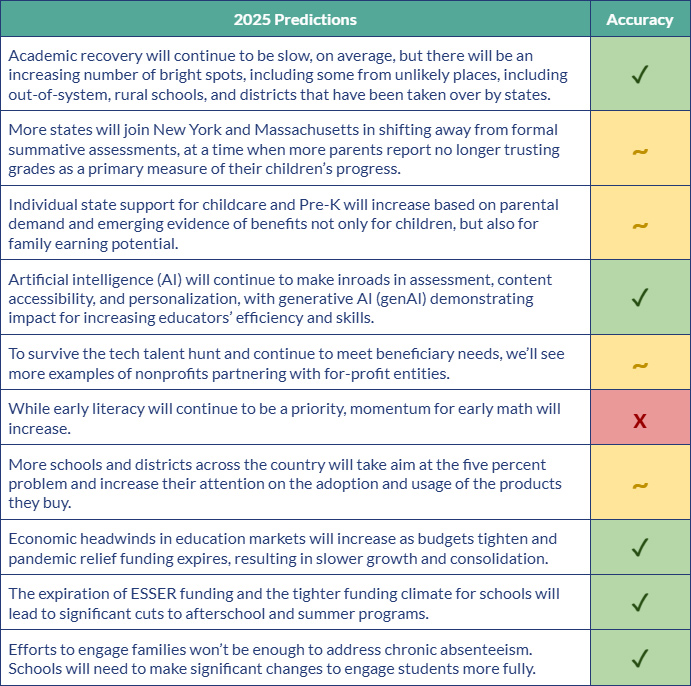
Just as important in this moment of reflection is analyzing how we fared with our past predictions—the areas we got right, the trends that unfolded in unexpected ways, and the shifts that are still in progress. We invite you to explore our full list of 2025 predictions, which we’ve summarized in the table below to reflect how we fared.
Below is our list of predictions for 2026:
Academic Achievement
1. Early-grade literacy will improve faster than math in the next assessment cycle, not because of new policies, but because science-of-reading reforms are finally changing daily classroom instruction in ways that math reforms have not yet achieved. —Anu Malipatil, Executive Director
Last year, we predicted that academic recovery would remain slow, on average, but that we’d see an increased number of bright spots, including some from unlikely places. This prediction held true, with NAEP results showing continued declines in fourth- and eighth-grade reading and math compared to 2019, with the steepest losses among the lowest-performing students. At the same time, bright spots emerged in the South, especially when it came to fourth grade literacy scores. And while the Education Recovery Scorecard reveals that the average U.S. student remains half a grade level behind pre-COVID proficiency levels, more than 100 school districts nationwide have surpassed those levels, showing impressive recovery.
In 2026, we anticipate that recovery will continue to accelerate, particularly for reading scores across grade levels in states and districts that have adopted science of reading-aligned policies and practices with a coherent vision for implementation. At the same time, we expect that math scores will continue to lag amid slower policy changes (37 states have passed laws to improve literacy versus just seven in math), lack of effective math preparation for educators, and lower pressure to apply cognitive science to math instruction. And while we predicted last year that momentum for early math would increase, we haven’t seen collective progress yet, suggesting that math scores will continue to be difficult to move.
2. Cell phone bans in later grades will reduce distraction and increase time on task and student attendance, leading to greater improvement in middle and high school reading and math scores, compared to earlier grades. —Meghan McCormick, Senior Research & Impact Officer
Twenty-two states enacted cell phone bans in 2025, with emerging evidence that these types of restrictions can positively impact student engagement in school. To better understand the impact of cell phone bans, we’ve provided funding to the Center for Education Policy Research (CEPR) at Harvard University to study the effectiveness of existing cell phone policies in schools, including those in states that are part of CEPR’s “States Leading States” initiative.
Assuming that our hypothesis is correct and that restricting in-school cell phone use leads to improved student engagement and learning conditions, we expect these policies to be more impactful in later grades, where cell phone use is more prevalent and distractions are greater. In these grades, reduced in-school phone use may increase time on task and focus, which could support learning recovery in reading and math. At the same time, we expect the overall effects of cell phone bans to be modest, underscoring that they are unlikely to be a standalone solution and that additional strategies will be needed to strengthen student engagement and academic outcomes meaningfully.
3. Federal testing will remain mandatory, but state-to-state variation will increase and accountability for results will remain ambiguous. —Elaine Perez, Director, People & Operations
In 2025, we predicted that more states would join New York and Massachusetts in shifting away from formal summative assessments. This prediction was semi-accurate, with states reducing the stakes and burden of traditional tests, but not eliminating them. For example, lawmakers in Texas passed a bill eliminating the end-of-year State of Texas Assessment of Academic Readiness (STAAR), instead opting for shorter assessments at the beginning, middle, and end of the school year. Similarly, Louisiana announced it will reduce the number of high school state assessments from six to four in SY 2026-27.
This year, we’re updating this prediction. Given the stasis from 2025, we believe federal testing will remain mandatory, but states will further decouple assessment from accountability ratings. We also believe that, even as testing infrastructure remains, federal enforcement will weaken dramatically, resulting in wider state-to-state variation despite the Every Student Succeeds Act continuing to require annual statewide assessments. This will increase ambiguity for educators, operators, and policymakers, placing greater pressure on education leaders to define quality internally and ensure that stakeholders, including families, are aligned.
Early Childhood Education
4. There will be early signs of momentum at the state level toward prioritizing and operationalizing Pre-K quality. —Carly Roberts, Senior Portfolio Manager, Early Impact
Last year, we stated that individual state support for childcare and Pre-K would increase based on parental demand. This prediction was semi-accurate: funding across the nation remains low, but some states are increasing funding or adding new policies, though those are mostly focused on childcare versus Pre-K specifically. As predicted, this push for funding has been driven more by parental demand and the post-pandemic childcare funding cliff rather than the evidence that shows high-quality childcare and early childhood education are beneficial for both children and families.
This coming year, we expect a small but growing number of states to move beyond aspirational definitions of quality and use concrete policy levers, such as curriculum guidance and implementation supports, to improve Pre-K instruction. The release of EdReports’ first-ever Pre-K curriculum reviews will serve as a catalyst for early adopter states interested in following the evidence, and states such as New Jersey, Louisiana, and Massachusetts will update their curriculum guidance and approval lists to incorporate green-rated Pre-K curricula. But while early adopters are always a positive sign, more field building will be needed to convince additional states to follow suit.
Artificial Intelligence
5. AI innovation will predominantly focus on improving existing solutions, versus reimagining teaching and learning. Innovation with potential to be disruptive, such as new school models like Alpha and Flourish, will be few and far between. —Josh Lotstein, Senior Director, Grantmaking
In 2025, we predicted that economic headwinds for education products would increase as budgets tightened and pandemic relief funding expired, resulting in slower growth and consolidation. This prediction was accurate—according to a study conducted by EdWeek Market Brief, 36 percent of education companies said their actual revenues were down in 2025, compared to 28 percent who said the same in 2024, and 33 percent of respondents said they would be reducing the size of their staff this year.
At the same time, AI-powered products somewhat complicated the picture of slower district purchasing. Our 2025 prediction that AI would continue to make inroads in assessment, content accessibility, and personalization was directionally correct, with AI products proliferating throughout classrooms nationwide, though it’s not yet clear whether student-facing AI personalization can drive strong student outcomes.
Despite this rapid spread, we predict innovation in 2026 will remain focused on improving the current state versus exploring what’s possible. Research from the Center on Reinventing Public Education reveals that even early adopter districts are in the early stages of experimentation, with 80 percent using AI for lower-hanging fruit, such as increasing teacher productivity or workflow efficiency, rather than designing new instructional or staffing models. Yet there are exceptions: from districts using AI to power competency-based learning or hybrid learning environments to entirely new project-based learning microschools built leveraging AI from the very beginning. We expect to see more of this, though reach will be limited as most schools and districts prioritize efficiency.
6. The rapid spread of generative AI content will test the field’s ability to implement high-quality instructional materials (HQIM) at sufficient dosage, but a handful of bright spots will demonstrate how intentional integration of AI can strengthen teaching and learning and foster instructional coherence. —Jessica Fredston-Hermann, Portfolio Manager, Exceptional Educators
In 2025, we predicted that more schools and districts would increase attention on adoption to tackle the five percent problem, which suggests that less than five percent of students use edtech products at the recommended dosage, limiting student learning. This prediction had mixed accuracy: we did see evidence that districts were being more scrupulous in their purchasing and reducing the number of tools they bought, with an increased demand for evidence. But we found little evidence that this shift has led to more effective usage of the tools districts do have, or greater impact for students. Where usage of core instructional tools has increased, it’s largely due to changes at the state level that incentivize implementation, such as Zearn Math in Texas, Louisiana’s HQIM policy, or the adoption of outcomes-based contracting. These examples, however, are the exception and not the rule.
This year, we predict that edtech usage will remain uneven and that the prolific availability of genAI products without guidance on quality or coherent usage will negatively impact how HQIM is implemented and utilized in the classroom. Given the lack of evidence on student-facing genAI tools and the risk of short-circuiting productive struggle, we worry that educator and student overreliance on this technology could ultimately lead to decreased learning, which would be particularly disappointing after years of growth in HQIM usage. At the same time, we remain optimistic that AI can help support HQIM usage when done intentionally to align with curricula and promote students’ deeper learning, such as the newly established partnership between Teaching Lab and Illustrative Mathematics.
Staffing and Talent
7. National discourse on the U.S. teacher workforce will shift from “teacher shortages” to growing concerns about teacher surpluses. —Jon Sotsky, Senior Director, Strategic Impact & Learning
Over the past several years, teacher attrition and hiring challenges have dominated education headlines and policy discussions, with reports showing persistent vacancies and a decline in new entrants into the profession. Though school systems in recent years have continued staffing up and even accelerated hiring using ESSER funding, student enrollment has continued to drop nationally, with declines of more than 1.2 million students since the start of the pandemic and continuing district-level losses in 2025 and 2026. This has reduced the student-teacher ratio dramatically in various ways across the country.
We predict 2026 will be the year we see a changing of the tide on teacher staffing discourse, driven by two underlying factors. First, a growing number of districts are being forced to consider school closures due to enrollment declines, which will have implications for teacher staffing needs. Meanwhile, teaching roles are comparatively insulated from AI-related job displacement relative to many other occupations, which will likely make teaching a more attractive and sought-after career choice over the next decade. Taken together, these factors point to a future that includes fewer but more sought-after teaching positions. (It’s worth noting that we had a similar prediction about educator layoffs in 2024, though we may have been too early to see the impact of teacher surpluses that year.)
8. The need for nonprofit tech and innovation talent will persist into 2026, leading to both strategic consolidation and growing in-house expertise. —Lucy Brainard, Director, Portfolio Success & Operations
Last year, we hypothesized that more nonprofits would partner with for-profit entities to survive the tech talent hunt. This prediction was semi-accurate, with some evidence of for-profit and nonprofit partnerships designed to provide tech integration and support, such as the Center for Outcomes-Based Contracting and Littera. But what we saw more of in 2025 was nonprofits partnering with each other to increase their impact and innovation capacity. For example, Teaching Lab and Relay Graduate School of Education announced plans to join together as one organization, and Magpie Literacy integrated Stanford University’s Rapid Online Assessment of Reading (ROAR) into its platform, enhancing its ability to provide educators with data on student progress. Additionally, nonprofits were eager participants in several AI accelerator programs, showing a desire and willingness to build in-house tech knowledge and skills versus outsourcing.
Looking ahead, we expect that strategic consolidation and mergers will continue as both for-profit and nonprofit organizations seek scale, alignment, and sustainability at a time of rapid innovation and change. We expect more partnerships and accelerated learning in the years ahead, with perhaps fewer standalone companies, though those that remain will have built their own tech capacity and talent.
Student Engagement
9. Given funding constraints and shifts at the federal level, out-of-school-time programs will pursue new and creative strategies to access public dollars via ESAs, education tax credits, and more. —Emma Banay, Senior Portfolio Manager, Inspired Minds
In 2025, we predicted that the expiration of the Elementary and Secondary School Emergency Relief funds and the tighter funding climate for schools would lead to significant cuts to afterschool and summer programs. This prediction was accurate. The Afterschool Alliance estimates that over $10 billion in ARP and ESSER funding supported around five million additional students in afterschool and summer learning between 2021–23. This loss was compounded by unpredictability in 21st Century Community Learning Center funding at the federal level in 2025. During this period of funding shifts, out-of-school programs have experienced increased demand and decreased slots: of the 29.6 million children whose parents want afterschool programs for them, more than three in four are unable to participate.
Looking ahead, we worry that these programs, despite the benefits they provide students and families, will continue to be underfunded via traditional sources such as 21st Century and district-level contracts. States and local governments will fill some gaps (such as the SAIL Program in Alabama), but we anticipate that providers will need to get increasingly creative and employ new strategies to access public dollars. We’re tracking how the increasing use of Education Savings Accounts might change nonprofit organizations’ sales strategies in states that have embraced this approach; how the new education tax credit created by the One Big Beautiful Bill Act might generate new dollars for out-of-school-time providers; and whether anticipated settlements from state-level social media lawsuits might subsidize youth development offerings for kids. Given the perennial funding challenges in the sector, these new opportunities may be more attractive—and necessary—for out-of-school organizations to meet increasing family demand.
10. Schools with rising academic achievement will have enacted policies and practices to both minimize distractions and enhance student learning. —Lina Eroh, Senior Director, Communications
Last year, we predicted that family engagement practices would not be enough to address chronic absenteeism or improve student engagement. And while many districts have improved family engagement, absenteeism remains high, and too many students still say they aren’t engaged in their learning. There are outliers, however: districts that have prioritized engaging afterschool programs have seen high attendance rates and student engagement metrics.
In 2026, we expect absenteeism to remain high and achievement to remain low unless districts take action to both minimize distractions (through cell phone bans, for example) and enhance the student learning experience through more hands-on learning both in- and out-of-school. We’re excited to track bright spots that show what’s possible when both things are done in tandem and highlight those as exemplars for the field. While we fear that some districts may prioritize academic achievement before student engagement, we remain optimistic that there’s untapped opportunity to drive achievement by better engaging students in their learning, and are excited to look for opportunities to invest against this hypothesis.