
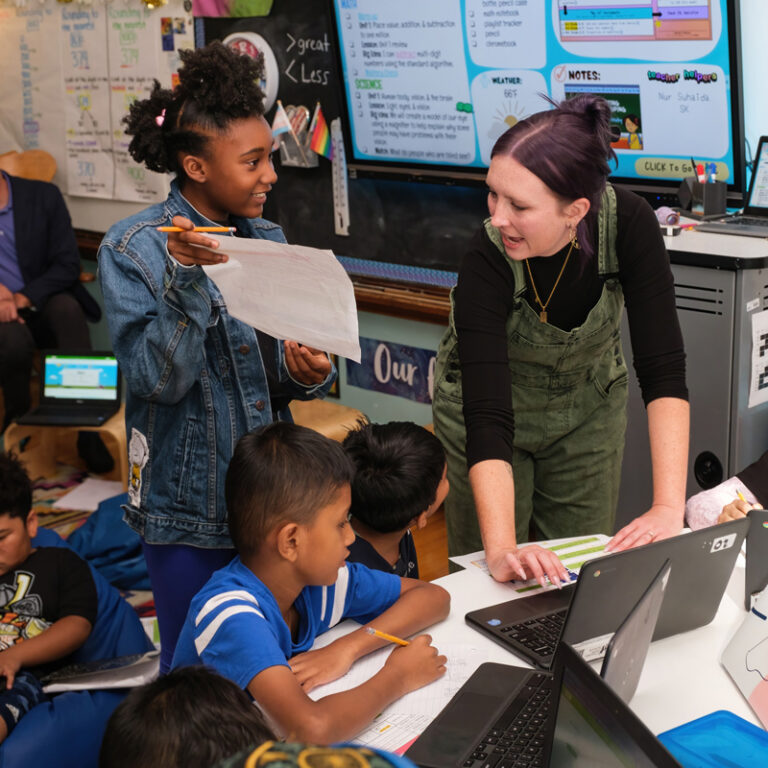








Zearn Math, created by the nonprofit Zearn, is a top-rated kindergarten through eighth grade math platform used by one in four elementary-school students and more than one million middle-school students nationwide. Zearn Math supports mastery of grade-level math for all students through independent digital lessons, instructional materials, student performance insights, and training and implementation support for educators.
A 2025 randomized controlled trial conducted by RAND estimated the impacts of Zearn Math in third through fifth grade in sixty-four schools in Texas serving high proportions of economically disadvantaged, Hispanic, English-learner, and below-proficient students. Researchers found small positive, but not statistically significant, effects of Zearn Math on the Texas standardized math achievement test (STAAR), and a statistically significant impact of 0.11 standard deviations—equivalent to about four percentile points—of Zearn Math on the MAP, an adaptive assessment of math achievement used by the district. Notably, there was a large difference in usage of Zearn between year one and year two of the study period, suggesting Zearn could have larger effects when used at the recommended level of three grade-level lessons per week.
A separate quasi-experimental study conducted by Johns Hopkins University examined the impact of Zearn Math Supplemental on students’ math achievement when paired with dedicated implementation support. Researchers used propensity score matching to estimate the impacts of Zearn Math Supplemental on fourth through eighth graders’ math achievement across three Louisiana school districts, finding impacts of about .20 SDs on students’ math learning. Exploratory, non-causal analyses revealed that students who completed more on-grade-level lessons showed higher math achievement at the end of the year, regardless of treatment group.
Overdeck Family Foundation has funded Zearn’s work since 2018. Our support for the organization has allowed it to strengthen the quality, implementation, and innovation of its digital curriculum for kindergarten through eighth grade, while increasing its ability to measure impact at scale.